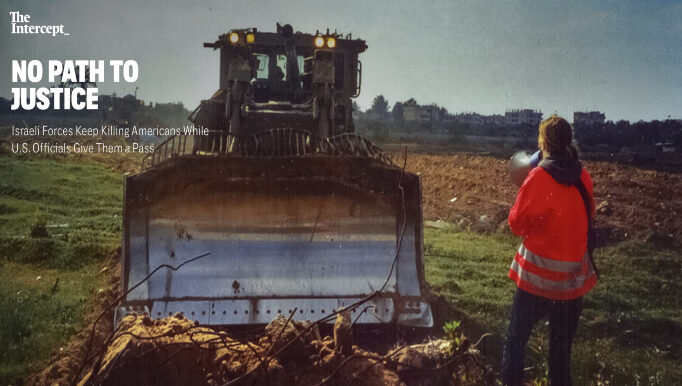
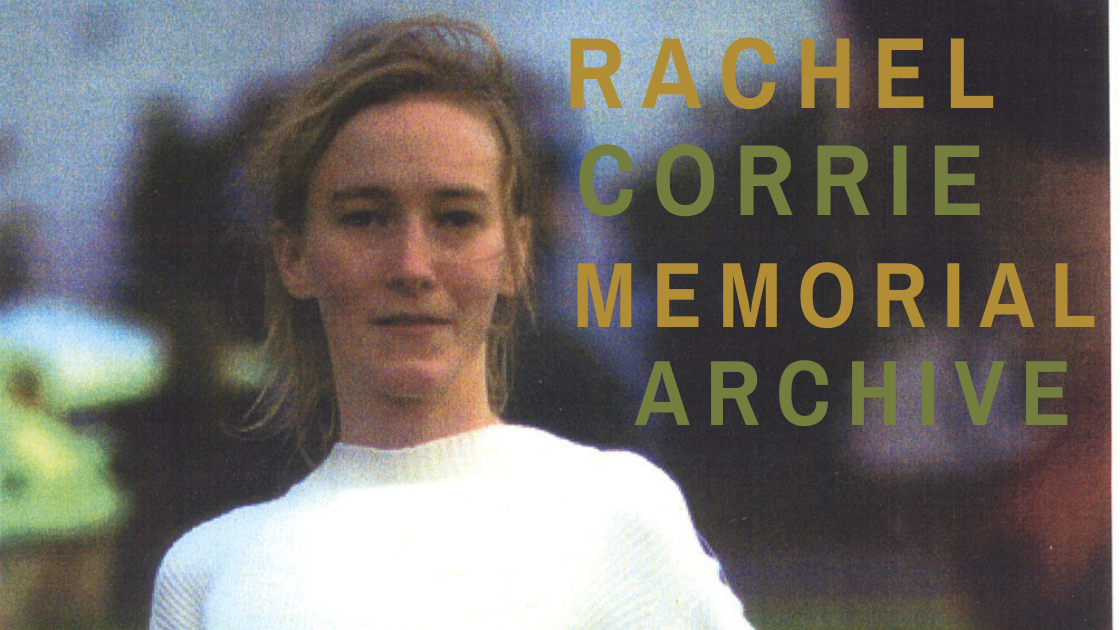
The Olympia Film Festival proudly presents the Northwest premiere of Simone Bitton’s (Wall) documentary Rachel, about Olympia native and Evergreen State College senior Rachel Corrie, who was killed in 2003 while attempting to prevent a Palestinian family’s home in the Gaza Strip from being bulldozed by the Israeli Defense Force. The film is a meticulous and rigorous investigation into the circumstances of Rachel’s death, which remains officially unresolved to this day, and features interviews with members of the International Solidarity Movement, the group with which Rachel was working at the time of her death, and current and former members of the Israeli Defense Force. In addition, the film illustrates the complexities of peace activism, through conversations both with those from whom Rachel drew inspiration and those who have made peace activism their life’s work. Howard Feinstein of ScreenDaily.com says, “Simone Bitton again proves that she is one of the finest contemporary documentarians with Rachel.”
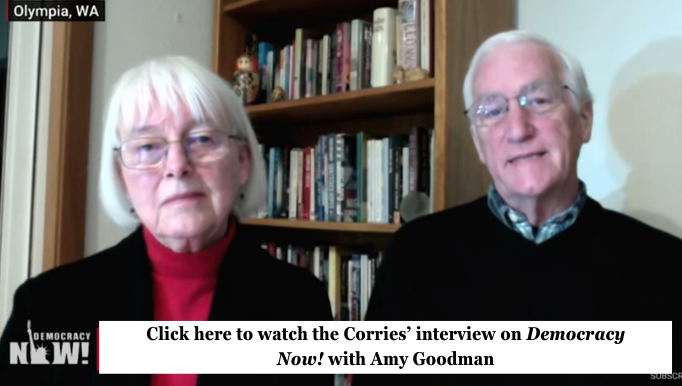
In attendance at the screening will be many current and former Olympians who knew, loved, and worked with Rachel Corrie, including her parents. This screening will be a special event that you do not want to miss.
A theatre near me is putting on a production of the play, “My Name is Rachel Corrie.” As elsewhere, the local production has drawn vigorous hassle from those who dedicate themselves to trying to punish any criticism in the U.S. of human rights abuses committed by the Israeli government.
Tonight there is a “talkback” after the performance. Some people are bringing handouts, and I was asked to write something.
In 1996, I was a volunteer for Christian Peacemaker Teams in the Palestinian city of Hebron. Shortly after I arrived in Hebron, 2 of us were arrested and threatened with deportation when members of the CPT sat on the roof of a Palestinian home that the Israeli army intended to demolish. In addition, friends of mine teach at Evergreen and had Rachel as a student. So when I was asked to write something, of course I said yes. Rachel’s story is close to my heart, not just as a symbol of human rights abuses carried out by the Israeli government with the acquiescence of the United States, but as a symbol of Americans putting themselves on the line for international solidarity. John Reed is buried in Red Square; veterans of the Abraham Lincoln Brigade have been granted Spanish citizenship. When the Palestinians regain sovereignty over Al-Aqsa, I hope they do something there for Rachel.
The Department of Anthropology, the office of the Vice President for Student Affairs, the Center for the Humanities, and the University Theatre of Oregon State University will present Alan Rickman’s and Katherine Viner’s My Name is Rachel Corrie, October 21-24, 7:30 PM, and October 25 at 2:00 PM in the Lab Theatre of Withycombe Hall, 30th and Campus Way. There will be free pre-show lectures (listed below) in the Green Room of the theatre at 6:30 PM exploring the events that formed some of the background of the play (Sunday talk begins at 1PM). There will be post-show discussions following every performance. Tickets are available at the door. A two dollar donation is suggested.
The play relates the story of Rachel Corrie, a student at The Evergreen State College in Olympia, Washington, who went to Gaza to work for Palestinian human rights and was tragically killed there on March 16, 2003. Rachel was a vital young woman driven by her need to make a positive difference in the world. Inspired by her story, and with permission from her family, Rickman and Viner edited Rachel’s diaries, journals, and e-mails to create this fascinating and moving portrait of this dynamic young woman. Newsweek said the play is “theater that not only stirs our hearts but sticks in our heads.” Time Out (London) said of the original production that it had “extraordinary power” and was funny, passionate, bristling with idealism, and luminously intelligent. The London Guardian reported that when theater is as “good as this,” it will “send us out enriched by other people’s passionate concerns.” USA Today noted that the play was “deeply, authentically human.” Rachel Corrie’s story has moved audiences around the world and there have been productions throughout the United States.
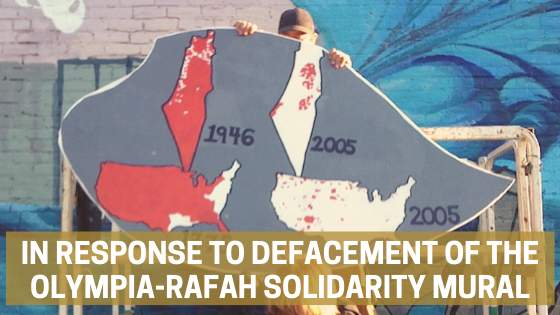
Please join us in celebrating the completion of the Mural (phase II) on Saturday, October 17th. We will honor all participants through a day of food, discussion, procession, music, dancing, and celebration. Highlights include Native American and Rachel Corrie Foundation delegates speaking on their recent trips to the West Bank and Gaza, and a workshop on Art & Activism.
Today we celebrate Eide, the day after the last day of Ramadan. I celebrate because I no longer need to duck under tables and behind counters to drink water “discreetly” between sunrise and sunset, It is the equivalent of Christmas Day for most Americans, if most Americans were more reverent and family oriented. People dress in their finest clothes and visit each other, bringing small symbolic gifts such as sweets to share.
People walk everywhere – small groups of very young girls wander down the streets together, no doubt watched from a short distance by a caring family member. And small “gangs” of 5-7 year-old boys run around playing the equivalent of cops and robbers with their friends. It reminds me of the American culture my father described from his childhood, and close to my childhood in Ohio in the late 50’s and early 60’s. Parents felt safer letting their children play, knowing that their neighbors and family would watch out for them. And the kids walk up to our group of strange foreigners, a little shy. When I ask if I can take their picture, they usually say yes. And then more and more kids want their picture taken, with a few, usually boys, really hamming it up. They smile or laugh at my clumsy attempts at Arabic, but are very polite and shake my hand. And there are usually smiling adults watching and smiling at us.